
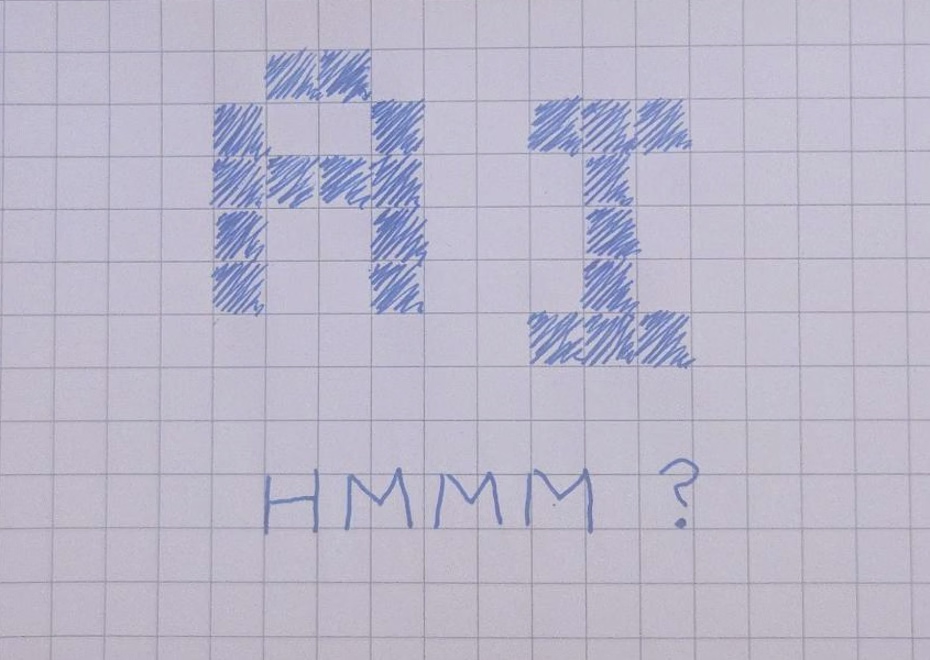
Pretty much every day now I receive pitches to incorporate AI into our local insurance agency.
Earlier today, I received a call asking me to hire an AI service to follow up on our quotes for us. Yesterday, an email offered me a full-fledged AI platform that would run my entire business, end-to-end! (See you at the beach!)
We’re a relatively small independent agency here in Hillsboro, Oregon. We provide mainly personal insurance like auto, home, and umbrella policies and, like many others, we’re thinking through what AI means for our agency. Should we incorporate it?
Massive amounts of marketing dollars have invested those two letters, “A-I,” with magical excitement. (Monty Python fans may recall the knights who say “Ni”). AI joins a long list of buzzwords: internet, dot-com, internet, e-commerce, -tronic, etc. Notice two things: first, there’s often a reason for the buzz; second, a good buzz isn’t forever.
So, to demystify a bit, we’ll clarify that AI isn’t one thing; rather, AI is typically the application of LLM tech to a wide range of tasks, everything from generating a meme, an essay, or code to even carrying on a conversation. So I think it more helpful to say “AI tools,” rather than just AI because it allows for various applications.
While most promote the powerful novelty of AI (better for sales!), I believe the decision to use AI tools is similar to prior decisions about integrating any tools into existing work. People at one point had to make decisions about whether to incorporate carbon copy paper, copy machines, phone systems, or computers. (And those were the good ideas!) The questions remain similar: What does the tool accomplish compared to what we and our competitors have now? And what are the tradeoffs, the costs and benefits of adopting such a tool?
Along those lines, here’re my collection of thoughts as we get asked to incorporate AI tools into every nook and cranny of our independent insurance agency. Finally, I’ll wrap this up with some preliminary Basic Principles for AI Tools.
Should we use AI to generate content for our website?
To date, I have resisted appeals to use AI to generate or review content for our website. My reasoning is fairly simple, if generating content becomes so easy anyone can do it, most everyone will do it, in which case, more genuinely human content will become more scarce and, perhaps, more valuable. If I use AI to help me write, there are many studies show that, while it may improve some things, it also creates dependence and laziness in me. That tradeoff is rather personal!
Anecdotally, as I search the web for everything from work-related insurance projects to personal things like home projects, it does seem that some people using AI tools to generate content have done damage. While some searches seem to give me the answer I need, many bring me to something I can only describe as a cyber wasteland, a sort of animatronic ghost town where robots are still pouring drinks for clients who’ve long left town.
And now major companies are spending major resources to remediate the AI Slop Problem. Who knows how it’ll play out? Back on topic . . .
Should We Use AI Tools to Take Calls?
Many bigger agencies are using AI to do everything from answering basic policy questions, to screening calls, to scheduling appointments and taking notes on calls.
We’re not entirely opposed to this, but in our own interactions with these agentic services we remain unimpressed.
For example, our doctor’s office has begun using one of these. About a month ago, I called needing to schedule an appointment for a potentially serious medical concern. The nicely voiced bot asked the reason for my call and, after I told it my serious condition, the bot proceeded to offer an appointment 10 days later! That was in addition to taking more than 5 minutes to give it all the correct information. I called back later asking for a person. The person recognized the urgency, offered me an alternative appointment 2 days away and another suggestion for how to possibly get seen in one day.
For many cases, AI probably works okay. The office probably has saved money by paying for less human staffing hours. What were the tradeoffs? It made that gain by taking more of my time. And not that everyone responds this way, but I did feel less cared for by the office now and am more likely to look elsewhere. I’m not ordering a pizza! In time, AI will likely be trained for this situation.
Many of our own insurance carriers use AI for initial phone screening and it often take two to three minutes just to confirm policy #s and info. Often, the AI will tell me irrelevant information about the account. When I finally reach a person, the representative often asks to verify the information I already gave to the voice bot. In most cases, I’d rather just receive a callback so I don’t waste time going through a long chain.
Should We Use AI Tools for Our Emails?
Microsoft Copilot offers to summarize our emails. When I’ve experimented with it, the results are usually longer and less precise than my own thoughts. Additionally, they often read like something that was written by a corporate hybrid from compliance, HR, and a company-funded therapist. Each may have their place, but I don’t believe that’s what a client wants from an insurance agent, one who’s a person anyway.
Much AI advertising has now done a walk-down from actually doing my work to “coworking” on my email. This might be helpful, but not so far.
Occasionally, we’re receiving AI-written emails from clients. Thus far, they are needlessly long, often confusing, and sometimes require several follow ups.
Should we use AI tools for our SEO (Search Engine Optimization)?
I did find AI useful for doing an SEO analysis. The way it could synthesize online information and analysis into a decent report and suggestions was remarkable. However, it did hallucinate some results. On the one hand, because it provides information drawn from other online pools of information, the odds are that it provides average advice –not all bad. On the other, it does lack the decisive insight an experienced professional person might offer. (Note- That doesn’t mean it won’t sound like it has decisive insight. The tough part is, how do you know?)
AI for the little stuff?
A growing line of argument for “AI!” as it continues the walkdown to more modest AI tools is to “use AI for the little stuff” so that you have time to do more valuable things for your clients.
Here’s a variation from Salesforce:
“AI can handle repetitive tasks, so agents can focus on what they do best: building relationships with customers. . . . . AI can’t replace the human touch. When a customer is going through a difficult time, they need to speak to a real person who can understand their situation and offer empathy. AI can’t do that. . . . ” (Note- errant comma is original.)
This approach assumes several things I’m uncomfortable with.
First, this approach often assumes that the little stuff holds little value in our relationship with our clients. The reality is that little stuff such as scheduling an appointment with my doctor often presents a real point of relational connection. It is a chance to connect service with us people. The saying goes that to someone with a hammer every problem looks like a nail. I think that the tendency of someone pushing AI tools is to think of human interactions in basic transactional terms, to see our relationships as API calls.
Second, this proposal often assumes that the little stuff stands alone, that there aren’t additional concerns on clients’ minds when they reach out. When helping a client with one “little” thing like adding a driver, we often discover that they want help updating something else, that they could perhaps save money somehow, or that they would like to add another product. These are all things that build the trust needed to continue our relationship. Often, the ability to serve the client in this way depends on attentive and nuanced listening skills along with familiarity. (Oddly enough, these are the precise skills that AI tools erode because of what psychologists have called “cognitive offloading.”) People like attention that solves their problems.
Third, this proposal assumes that the main thing humans contribute is empathy. But offering empathy is one thing many AI tools do quite well; though, humans do seem to prefer human empathy even if it doesn’t sound quite as good! 🙂
Fourth, this assumes that AI tools won’t frustrate many of our clients. In our insurance agency, we service people of all ages and tech backgrounds. (Some of this is just a function of our size. Our agency is neither large enough to risk upsetting a portion of our clients on an untested tool nor to justify the workload of establishing a group of beta testers.)
Finally, for AI tools to work well, we’d need to give it access to our client information. For a small business like ours, we don’t have the expertise needed at present to do that wisely. If major corporations with millions of dollars and entire tech teams are messing this up, we’ll remain cautious in giving AI agents access to our data. (See Shadow AI, Rogue Agents, and Data Leaks among others.)
AI tools for quoting?
Some of our most valuable service as an independent insurance agency is providing thoughtful car, home, and umbrella insurance comparisons for Oregonians. We’ve found that when clients understand real differences in policy choices, they appreciate better pricing and thoughtful comments.
I’m convinced it’s worth spending a little time understanding the insurance we pay for. After all, your insurance choices now will outline what financial help is available after a home pipe leak, an earthquake, or a car accident with injuries. Shouldn’t we at least give it a bit of thought?
But can’t this whole insurance process be handed over to a well-trained AI agent?
Sure. There are companies dedicated to integrating AI and insurance. A company called Lemonade has been working for years with millions of venture capital to make AI tools central to their insurance and quoting. I did a test run with my personal insurance at Lemonade. From our agency in Hillsboro anyways, the results seemed designed to rush people along with continuous assertions that pricing was better. For my own personal insurance, Lemonade would’ve charged us way more for inferior policies.
This doesn’t mean other companies won’t improve. They maybe will. Company boardrooms and tech enthusiasts dream of automated systems that will effortlessly collect new clients, allow self-serve policies, and reduce employee headcount. They may achieve this, but I think that human involvement of the sort we provide will continue to be valuable, even in ways unexpected.
Should we use AI tools to develop our business plans?
I do think this is not an entirely bad idea for perhaps organizing plans or thinking about ideas we’ve possibly missed. AI tools seem good at helping organize info. However, because of the way the tools work, it will largely provide ideas that are already generally available, and it also brings the associated problems of cognitive unloading. (For me personally, the hard part of any business plan is not the plan, but the work and execution involved.)
In Sum
In our local insurance agency, I do think AI tools hold promise for gaining efficiencies, saving both companies and clients time and money. We expect that there will be some helpful implementations, but we’ll remain cautious adopters for now as we’ve mostly heard complaints and frustrations.
Meanwhile, I’ve begun a starter list of Basic Principles as I continue pondering.
Basic Principles of AI Use: For starters
Truth in labeling. The AI tool (whether a voice, generated content, or chatbot) must be clearly identified as such. In other words, the client should know they are not interacting with a human throughout the interaction.
Accountability. The AI tool must be integrated into a chain of responsibility that leads to a human. The person should be accessible (easy to reach), responsive (timely), and responsible (empowered to take and resolve the concern).
Relevant Scope. The AI tool must be trained within the appropriate context and provide the right data.
Truthful. The responses must be free of hallucinations.
Trustworthy (No Dark Patterns): The AI tool must interact with clients in ways that do not manipulate them.
Data Secure: The systematic data access must be secure.
Stress: The AI tool should lower client stress and provide the client with a better service.
Hidden Trade-offs: Any AI tool must be evaluated for less obvious tradeoffs. While potential financial and time gains are obvious, work to understand the new dependencies and cultural impact. What if an AI tool goes down? What if an AI provider raises their prices or is purchased? What if the AI takes less time for the business but more time from the client? How does an AI Etc.
Learn more About Us (actual people!), our Sensible Approach, or our Carriers.